
Recipes and the table7 min read
What can you make with a jar of jam?
Jam is not just a spread for bread: it moves easily from breakfast into cakes, sauces and autumn desserts.
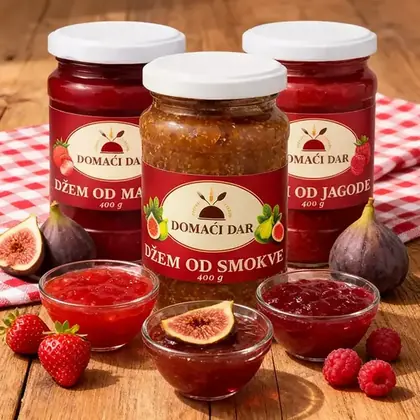
Jam is not just a spread for bread: it moves easily from breakfast into cakes, sauces and autumn desserts. Behind a slice of bread with a spoonful of jam there is concentrated fruit with sugar, and in the kitchen that can do much more than the morning toast allows. Below you will see how a jar from the pantry becomes a cake filling, the base of a sauce for meat and an addition to an autumn dessert.
Why does jam not stay on the bread?
Picture an ordinary Sunday: you opened a jar for breakfast, ate two slices and the jar went back into the fridge, where it will stand for weeks. Most opened jars end that way, not because the jam is not good enough, but because spreading is only one of its possible roles.
Jam has three qualities that are useful far beyond bread: a thick texture, pronounced sweetness and fruity acidity. The thickness lets it behave like a filling, the sweetness lets it replace part of the sugar in a recipe, and the acidity balances fatty or salty dishes. Once you see that, the jar stops being only breakfast and becomes an ingredient you plan the whole kitchen around.
There is a practical reason too. Homemade jam, especially from small producers, usually has more fruit and fewer additives than industrial jam, so it behaves differently in the oven or on the hob. It pays to treat it as a real cooking ingredient, not only as something you spread with a knife.
A good example is the preparation that leads to a recipe for the best plum jam. When plums simmer with sugar into a thick, dark mass, you can clearly see that you are getting an ingredient that is then easy to use in cakes and desserts. The same holds for every fruit jam, but it shows best with plums, whose flavour is strong enough to survive baking.
How does jam get into cakes and fillings?
In a cake jam can play two quite different roles. The first is a filling: a thin layer between sheets of pastry or in the middle of a cake. The second is an addition to the dough, where the jam is mixed in and replaces part of the sugar or fat.
For a filling, the jam must be thick enough not to run. If it is too thin, cook it down over a low heat for a few minutes, stirring now and then. For linzer biscuits, two-layer cakes or a roulade, a layer of one to two millimetres is quite enough: more and it seeps out at the edges, less and it disappears into the dough.
When adding jam to a dough the rule is simple: jam is both sweetener and moisture. If you add two or three spoonfuls to a muffin or sponge mixture, cut the sugar by a few spoonfuls, or the cake will be too sweet and sticky. Apricot or plum jam makes a cake softer, with a lightly caramelised crust.
A short starting point if you are not sure how to begin:
- Linzer biscuits and pies: thick jam, spread thinly, with no extra sugar in the dough.
- Muffins and kuglof: two or three spoonfuls mixed into the batter or dropped into the middle before baking.
- Roulades and pancakes: jam slightly warmed so it spreads easily, then cooled.
Remember that jam darkens and thickens as it bakes, so what looks light in the jar gives a deeper, almost caramel colour in the cake.
What does jam add to sauces?
This is where jam moves furthest from its usual image, and where it gives the most interesting results. A sweet-and-sour sauce with roast meat is nothing new: many traditional cuisines pair fruit with pork, chicken or game. Jam does it quickly and without fuss.
The method is simple. In the pan you roasted the meat in, add a spoonful or two of jam, a little water or wine, a pinch of salt and a few drops of vinegar or lemon juice. Simmer for a few minutes until the sauce thickens. The acid is the key: without it the sauce is only sweet, with it the sauce gains the depth that goes with meat.
The main question is how much sweetness the dish can take. With fattier pork or roast duck, plum or sour cherry jam balances the heaviness. With chicken choose something lighter, such as apricot or quince. With cheeses, from soft to hard, a spoonful of jam on the plate is almost a dish of its own.
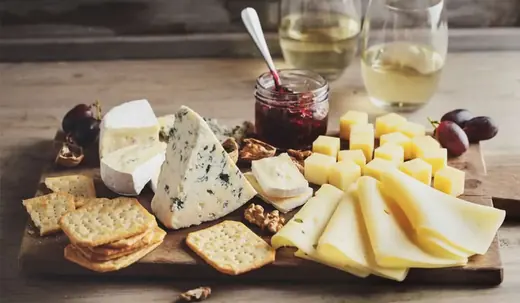
An everyday situation: a piece of cheese is left and there is nothing special for dinner. Put it on a plate, add a spoonful of jam, a few walnuts and a piece of bread, and you have a simple, satisfying meal. No recipe needed, just a good ingredient. Tips for relaxing after a working day can include a simple meal with no cooking.
One note: jam already contains plenty of sugar, so the sauce needs no extra sweetening. Taste it first, then add salt or acid if needed.
When does an autumn dessert ask for something different?
Autumn brings a different rhythm to the kitchen. The fruit arriving at the market, apples, pears, quinces and walnuts, asks for warmth and spice, and here jam acts as the ingredient that ties everything together.
Baked apples are a good example. Core them, fill them with walnuts, cinnamon and a spoonful of plum or sour cherry jam, and bake for about twenty minutes. Inside, the jam melts into a thick, aromatic syrup that needs no extra work. The same goes for pears or quinces, which are a little sourer by nature and take a sweeter jam well.
For a simple cake you can also use jam as a layer under the fruit. Spread a thin layer over the bottom of the tin, arrange apples or pears on it and pour the batter over. As it bakes the jam caramelises into a dark, glossy top when you turn the cake out.
If you do not want to bake, you still have options. A spoonful of jam over pancakes, porridge or yoghurt with walnuts makes a five-minute dessert. On colder days that is exactly what is needed: quick, warm and with no complicated recipe. A night out, then and now, often includes a late get-together over something sweet.
Interestingly, in autumn desserts jam often replaces the sugar you would otherwise add. Instead of sweetening the fruit separately, the jam does it for you, with a more intense fruit flavour as a bonus. Just do not overdo it, or the dessert can easily become heavy.
How do you choose what a jar of jam is for?
With all these possibilities, the question remains how to decide what to use and when. It helps to ask three simple questions, in the order you actually apply them in the kitchen.
First, what is the texture? Thick, almost spreadable jam works best as a cake filling. Thinner, syrupy jam suits sauces, a topping for pancakes or mixing into a dough. If it is too thick, thin it with a spoonful of water; if it is runny, cook it down.
Second, how much sweetness can the dish take? Meat, cheeses and savoury dishes want a jam with more acidity, such as plum, sour cherry or cranberry. Cakes and sweet desserts can take sweeter kinds, such as apricot, strawberry or peach.
Third, how much time do you have? In a hurry, a pan sauce with jam is ready in five minutes. Baked apples need half an hour, and a filled cake a whole afternoon. No option is better than another; it all depends on the day you are having.
Once these three questions become a habit, the jar in the pantry is no longer a single ingredient. It becomes a tool you adapt to the occasion: today for the Sunday cake, tomorrow for a sauce with dinner, the day after for a simple dessert with coffee.
What used to be just a slice of bread with jam now holds many more possibilities, and they are all in one open jar on the shelf.
More from the blog

Recipes and the table5 min read
A homemade table outdoors: ideas for get-togethers in the warmer months
The warmer months move get-togethers outside, where layout, shade and comfort matter more than indoors.
Recipes and the table7 min read
The 6 favourite salad dressings: from the classics to unusual homemade flavours
Which salad dressing to choose? Six favourite dressings, simple recipes, and the dishes each goes with best.
Small producers6 min read
How to combine a weekend trip with meeting domestic producers
It is worth planning ahead how visits and rest can fit into the same weekend; these tips make it easier.
Everything in this article comes from domestic producers
Browse the shop by category, or see the producers behind the products.